This was not my usual holiday.
There were no lazy mornings, predictable sightseeing stops, or frantic attempts to photograph everything before the next tourist walked into the frame.
I spent four days following the trails of the Tamirabharani ;Tamil Nadu’s perennial river on a pilot journey curated by Heritage Inspired.The river rises in the Pothigai Hills, flows through landscapes shaped by centuries of history and human life, and finally surrenders itself to the Gulf of Mannar. Somewhere along the way, the journey began to feel less like tracing a river and more like walking through the stages of life
Travelling Outside My Familiar World
Heritage Inspired was conceptualised by Anand, who stepped away from the comfort of routine to build a community where people travel not merely to see places, but to understand their history and experience culture from its roots.
Most of my fellow travellers had journeyed with Heritage Inspired before. They were also Tamil speakers. I was the non-native Tamilian in the group, a Christian by faith, and at 43, apparently old enough to question certain ideas about Sangam-era romance. 😉
In those poems, the thalaivan disappears for days or months while the thalaivi pours her pain of separation into poetry.
My immediate thought was: Why is she waiting?🤔💭
Perhaps she could travel, build a life, and return with stories of her own. When the hero eventually comes back, he might discover that she had better things to do than wait for him and decide that travelling together was the wiser option. 😊
This interpretation may owe more to my gender and age than literary scholarship. I accept that. 🙂
The Beginning in Kurinji (Mountains) and Mullai (Forests) :
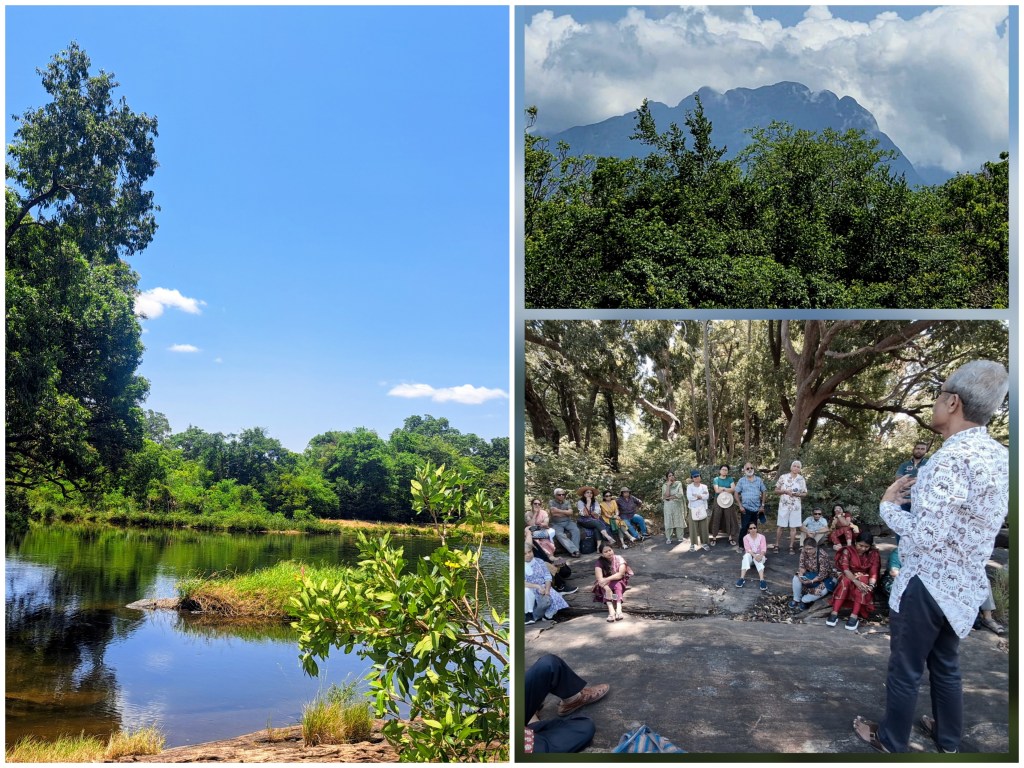
Since we could not visit Agastyarkoodam, where the river originates, our story began at the foothills. Heritage Inspired’s scholars introduced us to the forests, wildlife, and communities surrounding the river.
The Tamirabharani flows throughout the year because the forests absorb rainwater like a sponge and release it gradually. It was a simple but powerful reminder that nature sustains life not through force, but through balance.
The Kani people have understood this for generations. They do not dominate the ecosystem. They observe it, adapt to it, and live within it.
At a roadside shop, we met a Kani woman who casually mentioned travelling to Chhattisgarh for tribal conferences. She also slept in her shop, not because her home lacked anything, but to protect her bottles of oil from a wild bear that enjoyed drinking them.
There she was, prepared to defend her shop against a bear twice her size, while many of us consider a two-inch insect inside the house a full-scale emergency.
Perspective arrives in unexpected forms. Sometimes it arrives as a river. Sometimes as a fearless woman guarding cooking oil from a bear 🐻.
This part of the journey felt like infancy: a stage when life is held, protected, and nourished by everything around it. 👶
Adulthood: Marudham (Fertile Plains) and Palai (Red Deserts)
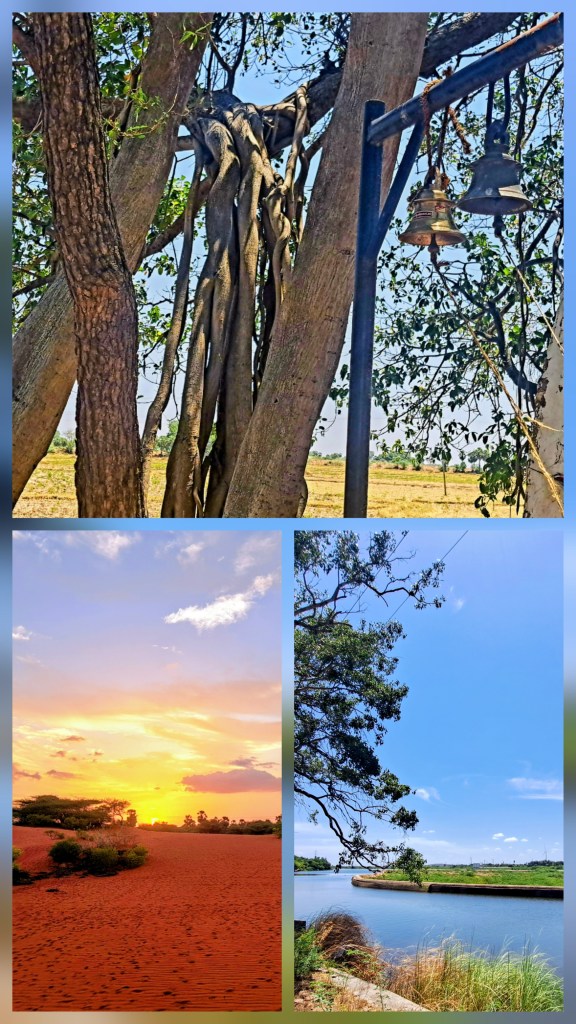
Further downstream, we entered Marudham, the fertile agricultural plains.
The highlight for me was the ancient Marudhuri check dam. Dr. Pramod explained how its V-shaped stone structure distributes water into two channels without relying on complex mechanical gates. When the river overflows, the surrounding plains receive the surplus, helping reduce the force of flooding.
This was more than engineering. It was a philosophy for life and community: share the surplus rather than imprison the river.
No attempt to overpower nature. No insistence that all the water must belong to one place. Just an intelligent design that allowed the river, the land, and human settlements to grow together.
Then came Palai, a vast expanse of crimson-red sand glowing beneath the setting sun. No photograph could quite capture it. I had always imagined a desert as colorless and barren; this landscape was anything but that.
In Sangam literature, Palai represents separation. Right on cue, as we listened to stories of separated lovers, a couple nearby was filming what appeared to be their pre-wedding shoot.
Ancient poetry mourned separation. Modern romance had coordinated outfits, professional lighting, and probably a drone. History remains. Our interpretations certainly evolve.
Together, Marudham and Palai felt like adulthood: building, striving, adapting, and learning resilience. Then, slowly, comes the realization that growth is not always about accumulating more. Sometimes maturity is knowing what to release so that you can protect your inner peace.
Neidhal (Coastal Region) : Where the River Lets Go
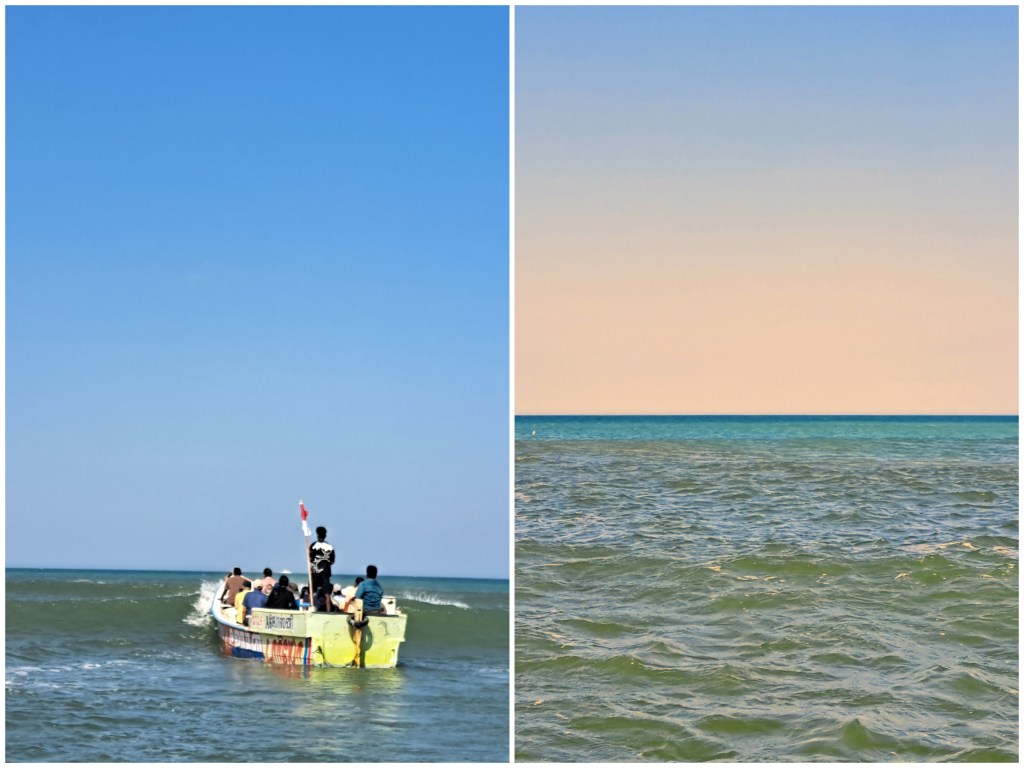
Passing through Korkai, we reached Neidhal, the coastal landscape of Punnakayal where the green waters of the Tamirabharani merge into the blue vastness of the Gulf of Mannar.
Local fishermen took us by boat towards the estuary. The stillness of the river gradually gave way to the tides of the sea. Members of the local community spoke about their daily lives, their hardships, and the leaps of faith they take every day to keep their families and communities going.
Watching the river disappear into the sea felt deeply personal. It reminded me of the final stage of life when the individual self leaves behind its familiar shape and becomes part of something larger, more powerful, and perhaps divine.
Dr. Pramod recalled a scholar’s question: Why does a dying person ask for water? Perhaps it is not merely thirst. Water is fundamental to every living cell; maybe it is the body’s final attempt to hold on before returning to the universe from which it came.
I do not know whether that is science, spirituality, or poetry. Perhaps it does not need a label.
More Than a River
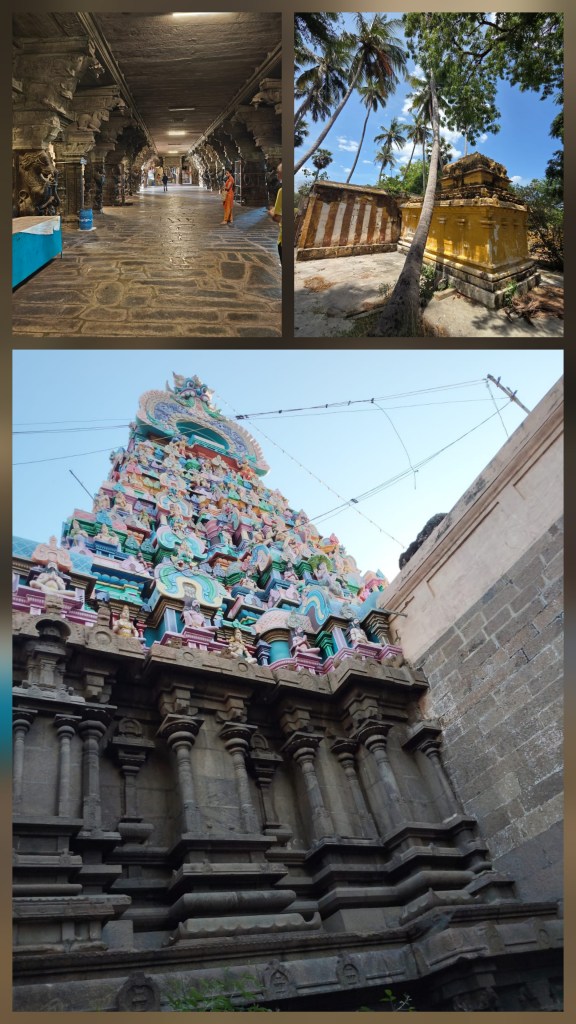
The journey was also filled with temples whose beautiful pillars and walls carried stories far beyond worship. These were once places where communities gathered, economies developed, and ideas travelled.
The architecture revealed how one dynasty (Cholas) adapted to the architecture of another (Pandya Dynasty), while the connected Agraharams showed traces of a slower, more communal way of life. Even as the digital world enters these homes, conversations continue on verandahs. People still share their histories with strangers who arrive with curiosity.
And then there was the food.
Halwa. Paal kova. Elaborate meals. Generous quantities of ghee.
Let us simply say that my soul was enriched and the fat and carbs were given its own immersive heritage experience.
What I Carried Home
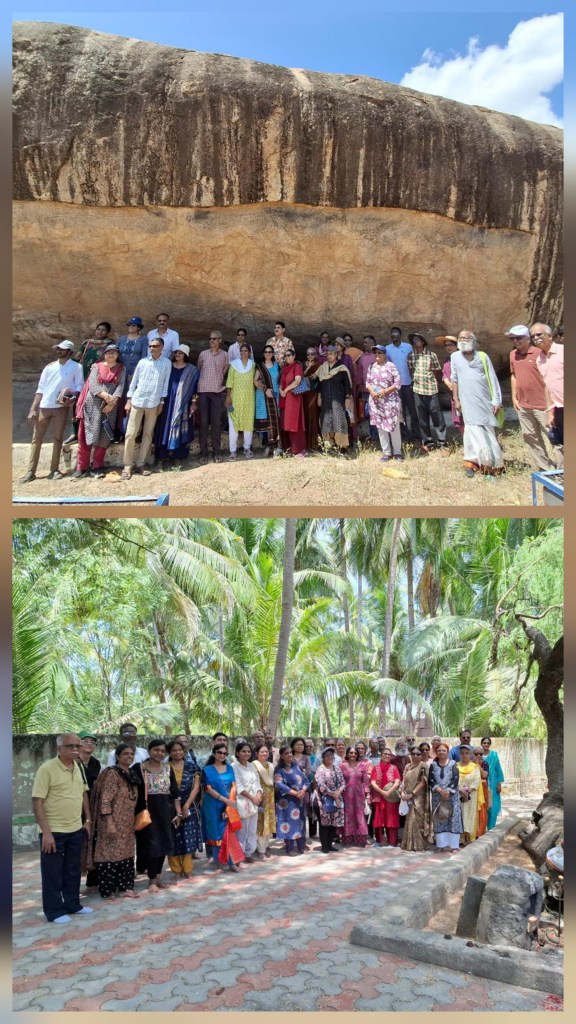
As I returned to routine, I realized that this trip would stay with me not only because of what I saw, but because of how thoughtfully the four days had been imagined and delivered.
Trails of Tamirabharani showed me life in motion: nurtured in the mountains, strengthened in the plains, tested in the desert, and finally released into the sea.
Heritage Inspired did more than tell us the river’s story.
Anand and his team created the space for each of us to find our own meaning within it.
As the journeys of Heritage Inspired team grow and reach more people, I hope they never lose the core- i.e revealing the hidden stories of India in a way that allows every traveler to carry home a deeply personal interpretation.
Not merely photographs.
Not merely facts.
But a small piece of India wherever they go.


Leave a Reply